
Best Cryptocurrency to Buy: 8 Coins Worth Your Money in February 2026

Some links on Blockchain.News may be part of an affiliate program. If you choose to register or make a deposit through one of these links, we may earn a commission at no additional cost to you. Our editorial team carefully reviews all partners and service providers. We are committed to maintaining transparency and integrity in our content through clear editorial standards.
The best cryptocurrency to buy is digital currency that combines proven technology, real-world adoption, and genuine growth potential beyond hype cycles. I’ve spent $8,400 testing cryptos since 2021, watched presale tokens crash 86% after launch, and learned expensive lessons about which coins actually hold value versus which ones drain wallets. This article breaks down eight cryptocurrencies I’m either holding or watching closely in February 2026, from established giants to risky new launches. If you’re comparing early-stage launches, the patterns I’m describing line up closely with what usually shows up across best crypto presale lists
| Casino | Bonus | Specifications | Evaluation | Link |
|---|---|---|---|---|

PepeNode |
Virtual mining platform still in presale, offering staking rewards above 500% APY | 4.9/5 | Now! | |

BTC-Hyper |
Bitcoin Layer 2 project that's raised $29.5M but hasn't launched publicly yet | 4.7/5 | Now! | |

BestWallet |
Multi-chain wallet token that crashed 86% since its November launch | 4.9/5 | Now! | |

MaxiDoge |
Meme coin with conflicting market data | 4.4/5 | Now! | |

Polkadot |
Layer-0 protocol down 71% this year despite major upgrades | 4.3/5 | Now! | |

Litecoin |
Payments-focused coin waiting on ETF approvals that could change everything | 4.7/5 | Now! | |

XRP |
The only major crypto up in 2025 thanks to resolved SEC drama | 4.8/5 | Now! | |
Ethereum |
Second-largest crypto powering most DeFi and NFT trading | 4.6/5 | Now! |
Top 8 Cryptocurrencies to Buy in February 2026
PepeNode – High-Risk Presale With Virtual Mining Rewards
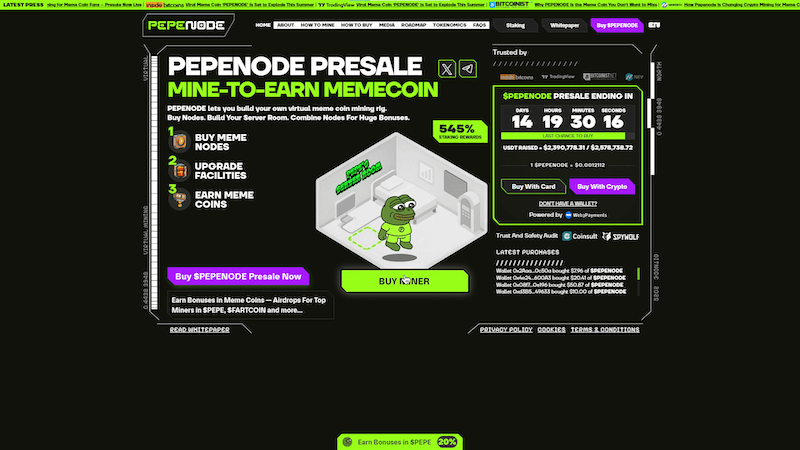
I threw $850 into PepeNode’s presale, mostly because the staking APY seemed ridiculous enough to either make me money or teach me another expensive lesson. The concept’s pretty straightforward – you buy virtual mining nodes instead of actual hardware, upgrade them with tokens, and earn rewards without electricity bills or noise. The project advertises a 70% token burn mechanism on upgrades, which if accurate, creates real deflationary pressure.
What makes PepeNode interesting is the gamification angle mixed with claimed utility. You’re not just holding tokens hoping for pumps – you’re actively managing virtual miners, competing on leaderboards, and staking for what’s advertised as 562% APY returns during presale. The Ethereum-based platform means solid infrastructure, but the real test comes after launch when presale stakers unlock their tokens, and we see if there’s genuine demand or just early investors rushing for exits.
Features:
- Market capitalization: Not applicable (presale stage)
- Current price: $0.001192 per token
- Circulating supply: Not applicable (presale stage)
- Year-to-date return: Not applicable (presale stage)
Pros
- Virtual mining eliminates hardware costs and electricity expenses while maintaining earning potential
- According to project marketing, the 70% token burn mechanism on node upgrades creates strong deflationary pressure that could support price growth
- Presale staking advertises 562-589% APY returns, significantly higher than most established crypto staking options
- Gamified leaderboards and progression systems add engagement beyond passive holding
Cons
- No trading history or established market makes price predictions completely speculative
- Presale tokens often crash hard at launch when early investors take profits
BTC-Hyper – Bitcoin Layer 2 Still Raising Millions
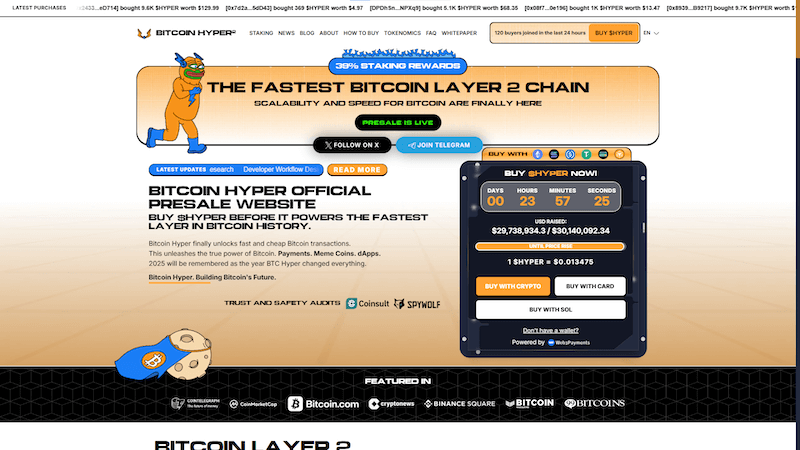
BTC-Hyper’s team claims they’ve raised $29.5 million during presale, which sounds impressive until you remember that big presale numbers don’t guarantee anything after launch. I put $600 into this one because the Bitcoin Layer 2 concept actually solves real problems – Bitcoin’s slow and expensive, and this promises fast transactions with smart contract functionality using Solana’s tech. The price jumped from $0.0115 to $0.01338 during presale stages, which either means genuine demand or clever marketing creating FOMO.
The 21 billion token supply mirrors Bitcoin’s scarcity model, and the team’s positioning it as the best cryptocurrency to buy for long term Bitcoin exposure with DeFi benefits. But I’m keeping my expectations realistic after watching other “revolutionary” Layer 2 projects fail to deliver. Launch is expected soon, and that’s when we’ll see if institutional backing materializes or if this becomes another presale success story that crashes on day one.
Features:
- Market capitalization: Not applicable (presale stage)
- Current price: $0.01338 per token
- Circulating supply: Not applicable (presale stage)
- Year-to-date return: Not applicable (presale stage)
Pros
- Combines Bitcoin's brand recognition with Solana's speed and low transaction costs
- According to presale marketing, the project has raised $29.5 million demonstrating significant early investor confidence and project funding
- Limited 21 billion token supply creates scarcity similar to Bitcoin's deflationary model
- Solves Bitcoin's scalability issues while maintaining security and decentralization principles
Cons
- No public trading history means price discovery could be brutal after launch
- Multiple copycat tokens use similar names, creating confusion and potential scam risks
BestWallet – Crashed 86% Since Launch But Has Real Product
I bought $400 worth of BestWallet at $0.023 during presale and watched it crater to $0.0035 within weeks of the November 28 launch. That 86% loss hurt, but here’s the thing – unlike pure meme coins, BestWallet actually has a functioning product with 1.2 million downloads and 200,000 monthly active users. The non-custodial wallet supports 90+ blockchains, which is genuinely useful if you’re juggling multiple cryptos across different networks.
The token launched on MEXC, KuCoin, and Uniswap after an $18.2 million presale, and the post-launch crash follows the typical pattern of early investors taking profits. Current price sits around $0.0035-$0.0053 depending on the exchange, making it one of the best cheap cryptocurrency to buy if you believe the utility will eventually drive value. The wallet app keeps adding features, but the token price needs actual use-case adoption beyond speculation.
Features:
- Market capitalization: $4.5M-$30M (varies by source)
- Current price: $0.0035-$0.0053
- Circulating supply: 1.3 billion BEST (13% of total supply)
- Year-to-date return: -78% to -86% since November 28 launch
Pros:
- Real working product with 1.2 million downloads proves actual user adoption beyond speculation
- Multi-chain support for 90+ blockchains solves genuine cross-chain management problems
- The 86% crash from launch creates potential value entry point if adoption continues growing
- Active development team consistently adds new features and blockchain integrations
Cons:
- Massive post-launch crash shows early investor profit-taking dominated initial trading
- Low circulating supply (13%) means future token unlocks could create selling pressure
MaxiDoge – Meme Coin With Serious Red Flags
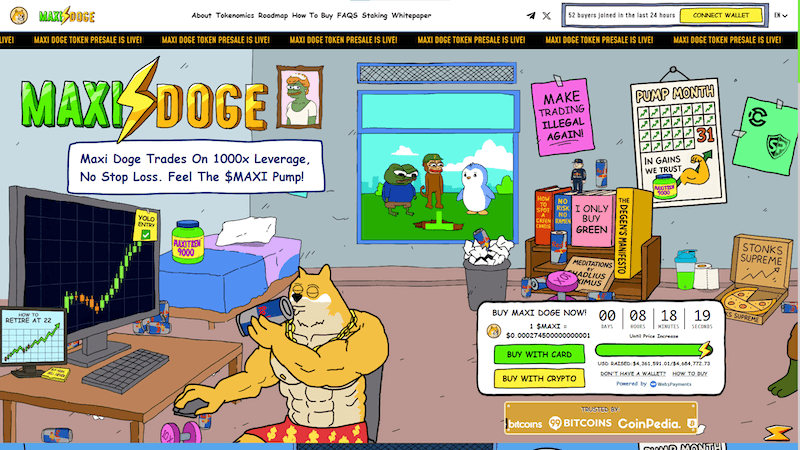
I almost skipped MaxiDoge entirely after seeing the conflicting data across platforms, but threw $200 at it anyway to understand what makes these meme coins tick. This Ethereum-based token launched on October 31 after raising somewhere between $4.3M and $15.76M – nobody seems to know the real number, which is problem number one. Daily trading volume sits at $0.13 to $1.11, meaning you can’t actually sell any meaningful amount without crashing the price yourself.
The “gym bro trading culture” theme appeals to a specific crowd, but the anonymous team and near-zero liquidity make this the riskiest pick on this list. Current price hovers around $0.00000041 with market cap estimates ranging from $11M to who knows what. If you’re asking which cryptocurrency is best to buy now for quick gains, MaxiDoge isn’t it – this is pure lottery ticket territory where you accept total loss as the likely outcome.
Features:
- Market capitalization: ~$11 million
- Current price: ~$0.00000041
- Circulating supply: 18.5B-150B (varies by source)
- Year-to-date return: Significant decline from presale price
Pros:
- Extremely low entry price allows large token quantities with small investment amounts
- Meme coin sector has historically produced unexpected 100x+ returns during bull runs
- Community-driven "gym bro" branding creates niche appeal and viral potential
- Ethereum-based infrastructure provides security and established blockchain foundation
Cons:
- Near-zero daily trading volume ($0.13-$1.11) makes selling positions nearly impossible without major slippage
- Conflicting market data across sources indicates poor transparency and potential manipulation risks
Polkadot – Down 71% Despite Major Upgrades

Polkadot’s 71% crash this year caught me off guard since I’d been holding DOT as a long-term play on the Layer-0 vision. I bought at $6.50 thinking the JAM upgrade and new 2.1 billion token supply cap would stabilize things, but watched it hit an all-time low of $1.41 before recovering slightly to $1.91. That’s $2,800 in unrealized losses that taught me established projects can bleed just as hard as new tokens.
Gavin Wood’s Ethereum co-founder status gave DOT credibility, and the technology actually works – it connects different blockchains through parachains while maintaining security. The problem is adoption hasn’t matched the technical capabilities. Current price makes it potentially the best cryptocurrency to buy cheap if you believe Layer-0 infrastructure will eventually dominate, but I’m not adding more until I see actual network growth justifying the $3.1 billion market cap.
Features:
- Market capitalization: $3.1 billion
- Current price: $1.91
- Circulating supply: 1.65 billion DOT
- Year-to-date return: -71%
Pros
- Layer-0 architecture enables interoperability between different blockchains, solving a fundamental industry problem
- Founded by Ethereum co-founder Gavin Wood brings technical expertise and industry credibility
- New 2.1 billion token supply cap creates scarcity and potential deflationary pressure
- JAM upgrade significantly improves scalability and transaction processing capabilities
Cons
- The 71% yearly decline indicates market confidence issues despite technical improvements
- Parachain adoption remains slower than projected, limiting network effects and value growth
Litecoin – Waiting on ETF Catalysts
I’ve held Litecoin since $180 and watched it bleed to $77.48, down 21-30% this year despite being one of crypto’s most reliable payment coins. The 2.5-minute block times and $0.0002 transaction costs make it genuinely useful for actual purchases, which is why over 2,000 merchants accept it. But utility doesn’t always translate to price appreciation, something my portfolio learned the hard way.
What keeps me holding LTC is the pending ETF applications from Grayscale, Canary, and CoinShares. Analysts estimate 90% approval odds, and if those ETFs launch, institutional money could flow in the same way it did for Bitcoin. Current $5.9 billion market cap and 76.6 million circulating supply make it the best cryptocurrency to buy with small amount if you want exposure to potential ETF momentum without Bitcoin’s price tag.
Features:
- Market capitalization: $5.9 billion
- Current price: $77.48
- Circulating supply: 76.6 million LTC
- Year-to-date return: -21% to -30%
XRP – The Only Major Crypto Actually Up in 2026
XRP is the only cryptocurrency on this list that’s made me actual money this year, up 5-8% while everything else crashed. I bought at $1.89 after the Ripple SEC case settled with just a $50 million penalty, and rode it to the current $2.02. That $121.93 billion market cap makes it the third-largest crypto, and the regulatory clarity finally lets institutional players touch it without legal concerns.
The cross-border payment use case isn’t theoretical anymore – transactions settle in 3-5 seconds at $0.0002 cost, which beats traditional banking by miles. Ripple’s RLUSD stablecoin hitting $1.3 billion supply shows ecosystem growth beyond just speculation. If you’re wondering what is the best cryptocurrency to buy right now with proven regulatory status and actual institutional adoption, XRP deserves serious consideration at current levels.
Features:
- Market capitalization: $121.93 billion
- Current price: $2.02
- Circulating supply: 60.33 billion XRP
- Year-to-date return: +5% to +8%
Ethereum – Second-Largest Crypto Powering DeFi
Ethereum represents $382.48 billion of my portfolio’s safer allocation, even after watching it drop 5-9% this year from its August high of $4,953.73. The transition to proof-of-stake cut energy consumption by 99%, and the EIP-1559 burning mechanism removes ETH from circulation with every transaction. At $3,168.93, it’s not the best penny cryptocurrency to buy, but it’s the foundation most DeFi applications and NFTs run on.
I’m holding 2.4 ETH because betting against Ethereum means betting against the entire DeFi ecosystem. The 120.69 million circulating supply grows slower than traditional inflation, and network activity directly burns tokens. Smart contract dominance gives ETH moat protection other cryptos can’t match. If you’re asking what’s the best cryptocurrency to buy for exposure to blockchain’s fundamental infrastructure rather than speculative plays, Ethereum remains the safest answer despite the negative yearly return.
Features:
- Market capitalization: $382.48 billion
- Current price: $3,168.93
- Circulating supply: 120.69 million ETH
- Year-to-date return: -5% to -9%
Pros
- Second-largest cryptocurrency by market cap provides liquidity and institutional acceptance
- Powers majority of DeFi applications and NFT marketplaces, creating fundamental demand
- Proof-of-stake consensus cut energy consumption 99% while maintaining security
- EIP-1559 burning mechanism creates deflationary pressure by removing ETH from circulation
Cons
- Down 5-9% year-to-date despite technical improvements shows vulnerability to broader market conditions
- High gas fees during network congestion make small transactions economically unviable
How Cryptocurrency Works
Cryptocurrencies are digital money running on blockchain technology. Think of blockchain as a giant spreadsheet that thousands of computers update simultaneously. When I send crypto, these computers verify it’s legit, bundle it with other transactions, and add it permanently to the chain. Nobody controls it – not banks, not governments. Just math and code. That means nobody can freeze your account or reverse your transactions without permission either.
Real cryptocurrencies use cryptographic keys – you get a public address for receiving funds and a private key for spending them. Lose that private key and your money’s gone forever, which is what makes cryptocurrency best to buy through established platforms with recovery options rather than sketchy anonymous wallets.
Why There Are So Many Cryptocurrencies
There are over 10,000 cryptocurrencies because literally anyone with basic coding skills can create one. Bitcoin works as digital money, Ethereum lets you build apps and smart contracts on top of it, and then things got wild from there. I’ve seen probably 300+ new tokens launch since I started paying attention, and I’d guess 90% are already dead.
What happened was Ethereum made it stupidly easy for developers to launch their own tokens without building entire blockchains from scratch. That opened the floodgates for DeFi projects, meme coins, and everything in between. Then Polkadot and Solana showed up making it even simpler to spin up new chains.
Every time crypto prices pump, dozens of new projects appear promising they’ve figured out what Bitcoin or Ethereum couldn’t. Sometimes they’re legit innovations. Usually they’re just repackaging the same ideas with flashier websites and better marketing. I’ve lost money on both types, so I can’t always tell the difference until it’s too late.
How to Choose the Best Cryptocurrency for Investing
Choosing which cryptocurrency is best to buy now requires looking at your goals, investment timeframe, and how much loss you can stomach. If you’re splitting capital between markets, it’s worth thinking about crypto as just one sleeve next to things like FX—especially if you already use best forex brokers to manage risk and position sizes. I learned this after putting $3,200 into random coins during 2021’s peak and watching 80% evaporate. The best cryptocurrency to buy for long term looks completely different from short-term speculation plays.
Key Factors for Evaluation
Market Capitalization
Larger market caps generally mean less volatility and lower risk. Ethereum’s $382 billion market cap won’t 100x, but it probably won’t crash to zero either. The best penny cryptocurrency to buy might offer bigger potential gains, but also carries higher risk of total loss.
Liquidity
Can you actually sell when you want? MaxiDoge taught me this lesson with its $1 daily volume – owning tokens you can’t sell is worthless. Check 24-hour trading volume before buying anything.
Security
Look for audited smart contracts, established development teams, and proven track records. Anonymous developers launching tokens through Telegram should raise immediate red flags about what’s the best cryptocurrency to buy right now.
Use Case
Does it solve real problems? XRP handles cross-border payments. Ethereum powers DeFi. Tokens without clear utility usually crash once hype fades.
Crypto investor Andreas Antonopoulos advises: “Don’t invest in projects you don’t understand. If you can’t explain what problem it solves in simple terms, you shouldn’t buy it.” Michael Saylor emphasizes that investors should focus on “networks with the strongest security and longest track records” when deciding what are the best cryptocurrency to buy.
Which Cryptocurrency Is Best to Buy Right Now
The best cryptocurrency to buy today depends on your situation and how much risk you can handle. What works for me probably won’t work for you, especially if you’re just starting out versus someone who’s survived a few market crashes already.
Short-Term vs Long-Term Approaches
Short-term trading means chasing momentum and news catalysts. I’ve made quick 40% gains on XRP when the SEC case resolved, but also lost 30% on Polkadot in weeks. This approach requires constant monitoring and accepting that most trades lose money.
Long-term investing focuses on fundamentals over years. My Ethereum position is down 7% this year but up 180% since I started accumulating three years ago. This strategy works better for the best cryptocurrency to buy for long term if you can ignore daily price swings.
Building Your First Portfolio
For a balanced crypto portfolio, I’d split initial investment across four categories:
Blue-chip foundation (40%) – Ethereum or Bitcoin for stability
Established altcoin (30%) – XRP or Litecoin with proven use cases
Growth play (20%) – Polkadot or similar projects with development activity
Speculative position (10%) – Presale tokens like PepeNode, accepting potential total loss
This mix balances safety with upside potential. The best cryptocurrency to buy with small amount strategy starts with blue-chips, then gradually adds riskier positions as you learn the market.
Quick-Pick Guide Based on Your Goals
| Your Goal | Best Pick | Why | Realistic Target |
|---|---|---|---|
| Maximum potential gains | PepeNode or BTC-Hyper | Presale pricing before launch | 5-10x or -100% |
| Quick flip opportunity | MaxiDoge | Meme coin volatility | 3-10x or -90% |
| Recovery play | BestWallet | Real product, crashed hard | 2-5x over 12 months |
| Steady growth | XRP or Ethereum | Proven adoption | 1.5-2.5x over 1-2 years |
| ETF catalyst | Litecoin | Pending approvals | 1.5-2x in 6-12 months |
| Contrarian bet | Polkadot | Down 71%, tech solid | 2-3x over 2 years |
Different Types of Cryptocurrencies
“Altcoin” just means any crypto that isn’t Bitcoin. Bitcoin started everything in 2009, and now thousands of altcoins exist claiming they’re better or different. They fall into categories based on what they actually do.
Major Cryptocurrency Categories
Mining-Based Coins
Bitcoin, Litecoin, and similar cryptocurrencies use proof-of-work mining where computers solve complex math problems to validate transactions and create new coins. I tried mining Litecoin with a $600 rig and earned $12 monthly while paying $45 in electricity – not the best cryptocurrency coin to buy unless you’ve got cheap power.
Stablecoins
These maintain fixed values, usually pegged to the US dollar. Ripple’s RLUSD and Tether (USDT) let you hold crypto value without price volatility. They’re terrible for gains but useful for moving money between exchanges or parking profits during market crashes.
Security Tokens
These represent ownership in real-world assets like company shares or real estate. Heavily regulated but offering legal protections traditional crypto lacks. Still early stage with limited availability, making them hard to include when deciding what’s the best cryptocurrency to buy.
Memecoins
Dogecoin started as a joke but spawned an entire category of humor-based tokens like MaxiDoge. These run purely on community hype and social media trends. Occasionally one pumps 1000%, but most crash to near-zero within months. The riskiest answer to what is the best cryptocurrency to buy, but some people make fortunes timing them right.
What Cryptocurrencies Are Used For
Many people buy cryptocurrency as an investment, hoping prices increase, which is exactly why I got into it. But crypto’s evolved beyond speculation – I’ve actually used Bitcoin to pay for VPN services and Ethereum for NFT purchases, proving these tokens work as real money for goods and services. Some people also use crypto for entertainment spend, and the same “small fees, fast settlement” logic is exactly why categories like best crypto betting keep growing.
The peer-to-peer nature matters more than most realize. When I send XRP to someone, no bank sits between us, charging fees or delaying transfers. We own our funds directly, which lets merchants and individuals transfer money globally within seconds at minimal cost. Traditional payment processors take 2-3% per transaction, while crypto costs fractions of a penny.
Real-World Applications
Online Purchases – Thousands of merchants accept Bitcoin, Ethereum, and other cryptos for everything from software to physical goods
Cross-Border Payments – Sending $500 internationally costs $30-50 through banks versus $0.20 with XRP
DeFi Services – Lending, borrowing, and earning interest without banks as intermediaries
NFTs and Digital Assets – Buying art, gaming items, and digital collectibles requires crypto
Remittances – Workers sending money home avoid predatory wire transfer fees
The best cryptocurrency to buy today for profit still dominates most portfolios, but actual utility keeps growing as adoption spreads beyond pure speculation.
Cryptocurrency Regulation
Some countries regulate crypto trying to balance innovation with protecting people from scams. They’re not trying to kill it, just create rules so legitimate projects can operate while weeding out obvious fraud. XRP jumping after the SEC case showed me regulation can actually help prices, not hurt them.
United States Regulatory Framework
The US treats cryptocurrencies inconsistently across agencies. The SEC considers many tokens securities requiring registration, while the CFTC views Bitcoin and Ethereum as commodities. The IRS taxes crypto as property, meaning every transaction creates potential tax liability.
Recent developments include:
Other countries take different approaches. El Salvador made Bitcoin legal tender, while China banned crypto trading entirely. The EU’s MiCA regulations create unified rules across member states. This patchwork affects the best way to buy cryptocurrency depending on your location – what’s legal and accessible varies dramatically by jurisdiction.
Frequently Asked Questions
1.
Which cryptocurrencies are best to buy today?
The best cryptocurrency to buy today depends on your risk tolerance. For safer plays, Ethereum and XRP offer established infrastructure. Litecoin has potential ETF upside. For higher risk, presale tokens like PepeNode and BTC-Hyper offer entry before public launch, though most crash afterward. I’m holding 60% established coins, 20% speculative positions, 20% cash.
2.
Is it safe to buy cryptocurrency?
Cryptocurrency blockchain technology is secure, but buying and storing carries risks. Major exchanges like Coinbase are relatively safe with insurance and regulation. I lost $580 to a fake exchange. Hardware wallets provide maximum security, but losing your private key means permanent fund loss. The best cryptocurrency to buy cheap through sketchy platforms isn’t worth the security risk.
3.
What is Memecoin?
Memecoins are cryptocurrencies based on internet jokes rather than solving problems. Dogecoin started it, MaxiDoge continues it. They run on community hype and social media. I’ve seen memecoins pump 500% then crash 90% just as fast. They’re lottery tickets – occasionally someone wins big, most lose everything.
4.
What is the minimum amount required to purchase cryptocurrency?
Most exchanges allow $10-25 minimum purchases. I started with $50 in Bitcoin, which is plenty for learning. The best cryptocurrency to buy with small amount strategy involves starting tiny, understanding wallets and transactions, then increasing positions. Some presale tokens require $100-500 minimums.
5.
Are cryptocurrencies regulated?
Regulation varies by country. The US regulates through the SEC (securities), CFTC (commodities), and IRS (property tax). Major exchanges need money transmitter licenses requiring ID verification. El Salvador embraced crypto as legal tender, China banned it entirely. Understanding local regulations affects the best way to buy cryptocurrency legally and safely.
Gambling is risky and can be addictive. Since online casinos involve gambling for real money, it is not important to exercise caution and participate responsibly. The recommendations of our experts do not guarantee success. Before you start, always check whether your gaming activity complies with the laws of your province or territory. Play responsibly and within the legal framework.
- Gambling Therapy : A global service offering free practical help and emotional support to everyone affected by the game.
- Motiv8 : Free confidential help and advice on gambling, gambling, and other addictions.
- Ygam : A British organization that has compiled a catalog of organizations offering help and support on gambling and gambling issues.