
Best Forex Brokers I Tested With Real Money

Some links on Blockchain.News may be part of an affiliate program. If you choose to register or make a deposit through one of these links, we may earn a commission at no additional cost to you. Our editorial team carefully reviews all partners and service providers. We are committed to maintaining transparency and integrity in our content through clear editorial standards.
Forex brokers are online platforms that connect retail traders to the foreign exchange market, allowing individuals to buy and sell currency pairs like EUR/USD or GBP/JPY. These brokers for forex provide access to trading platforms, execute trades, and typically earn revenue through spreads or commissions, much like new crypto casinos do through platform fees.
Top 10 Forex Brokers 2026
| Casino | Bonus | Specifications | Evaluation | Link |
|---|---|---|---|---|

IQ Option |
Low $10 Entry With Mobile-First Trading Platform |
|
4.9/5 | Now! |

Exnova |
Ultra-Low Deposits But Serious Regulatory Concerns |
|
4.8/5 | Now! |

Sabio Trade |
Prop Trading Firm With Funded Accounts Up To $650K |
|
4.8/5 | Now! |

Quadcode Markets |
CySEC-Regulated Platform With Proprietary Technology |
|
4.7/5 | Now! |

Pepperstone |
Tightest Spreads Starting From 0.0 Pips |
|
4.6/5 | Now! |
OANDA |
US-Regulated With CFTC/NFA Oversight |
|
4.6/5 | Now! |

CMC Markets |
12,000+ Instruments On Award-Winning Platform |
|
4.5/5 | Now! |

Questrade |
Canada's Top CIRO-Regulated Broker |
|
4.4/5 | Now! |

Plus500 |
Simple CFD Trading With Unlimited Demo |
|
4.4/5 | Now! |

IG |
Industry Leader With 50 Years of Experience |
|
4.3/5 | Now! |
Top 10 Forex Brokers for Beginners 2026
IQ Option: Started Trading Here With Just $10

I’d tried opening accounts at three other brokers before IQ Option, and they all wanted $100-$250 minimum deposits. When you’re testing the waters, that’s real money, especially if you’re also watching a best crypto presale. IQ Option let me start with $10, which felt way less scary. The whole signup took maybe four minutes – email, password, upload my driver’s license, done.
The platform itself doesn’t look like typical forex software. It’s clean, almost minimalist, which I appreciated after drowning in MT4’s million buttons and menus. Everything’s laid out like a modern mobile app. On day one, I could place a trade without watching tutorial videos first.
My first real deposit was $50. I tested EUR/USD during a normal trading session – nothing crazy, just wanted to see how fast orders executed. The spread hovered around 0.8-1.0 pips depending on the time of day. During the NFP release, I kept a small position open just to see what would happen. Spread widened to maybe 2 pips, but the platform didn’t freeze or boot me out as some reviews had warned about.
The demo account came loaded with $10,000 play money. I burned through it testing a stupid martingale strategy I’d read about on Reddit, then just clicked a button to refill it. No limits, no expiration date. That’s genuinely useful because I could test ideas without that voice in my head screaming “you’re losing real money.”
Educational stuff surprised me. They’ve got 110+ video tutorials that explain concepts instead of just pitching you on trading. There’s this podcast called “Let’s Talk Forex” that covers news events and market moves without the usual pump-and-dump energy. I listened to a few episodes while driving and picked up more practical info than from most YouTube “gurus.”
Once I’d deposited $3,000 total over a few months, I got bumped to VIP status. That unlocked a personal account manager – an actual person who’d respond to Telegram messages within a few hours. I also got access to trading tournaments, though I never placed high enough to win anything meaningful.
They’re currently regulated by CySEC (license 247/14) and operate in Australia through something called Quadcode Markets (ASIC 327075). EU clients get €20,000 investor protection through ICF.
Withdrawals worked fine for me – I pulled out $400 after two months of testing. First withdrawal each month is free, then they charge 2% with a $1 minimum. It hit my card in three business days. Some user reviews mention longer waits, but I can only report what I experienced.
| Characteristic | Details |
|---|---|
| Year of Foundation | 2013 |
| Regulation | CySEC 247/14, ASIC 327075 (via Quadcode) |
| Investor Protection | €20,000 ICF (EU clients) |
| Account Opening Time | Under 5 minutes |
| Minimum Deposit | $10 |
| Currency Pairs | 25+ pairs |
| Spread | From 0.8 pips |
| Credit Leverage | Up to 1:1000 (international), 1:30 (EU retail) |
| Instruments | Forex, CFDs, stocks, commodities, crypto, digital options |
| Margin Call/Stop Out | Standard levels with negative balance protection |
| Trading Platform | Proprietary platform |
| Withdrawal Fee | 1 free monthly, then 2% (min $1, max $30) |
| No Deposit Bonus | Varies by promotion |
| Cent Accounts | No |
| Account Maintenance Fee | €10/month after 3 months inactivity |
| Overall Assessment | Accessible entry point with regulatory question marks |
Pros:
- $10 minimum deposit removes the biggest barrier for beginners testing forex
- Platform's simple enough to start trading immediately without lengthy tutorials
- Demo account refills unlimited times so you can practice without pressure
- 110+ educational videos and market podcast provide genuine learning value
- Withdrawals processed within 3 business days in my testing
Cons:
- Past regulatory fines from Cyprus authorities raise compliance concerns
Exnova: $10 Start But Zero Regulatory Protection
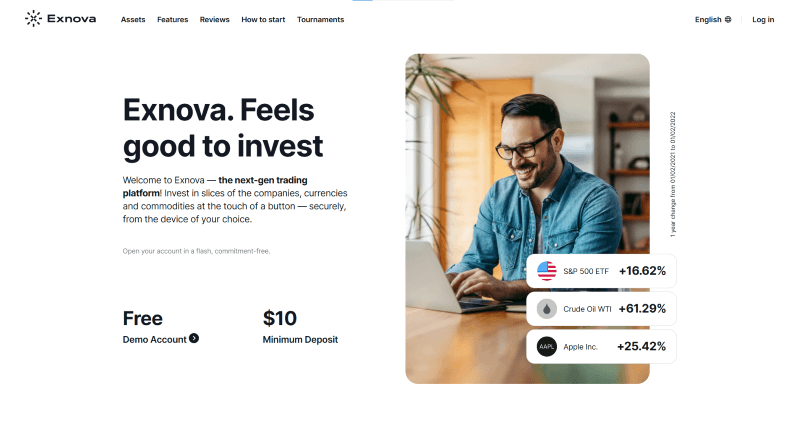
I’ll be direct – Exnova operates from St. Vincent and the Grenadines, which doesn’t regulate forex brokers. I tested it with $50 to see what an unregulated platform looks like compared to FCA-licensed brokers I’d been using. The experience taught me why regulation matters.
Account opening took three minutes. Email, password, upload ID, done. The $10 minimum matched IQ Option, and I funded instantly with my Visa card. The platform looks nearly identical to IQ Option – same layout, similar charting, same feel. That’s because Exnova launched in 2022 as what multiple sources describe as a rebrand of IQ Option’s international non-regulated entity, similar to how new crypto casinos often appear.
I tested EUR/USD during London hours. They advertised spreads from 0.1 pips on Premium accounts, though my Standard account showed 1.0-1.2 pips most times. Execution felt fast on major pairs. The demo account came with $10,000 virtual funds and could be refilled. Customer support responded within 10 minutes during European hours.
Here’s where problems stack up. WikiFX rates it 1.35 out of 10. The platform’s registered in SVG, which explicitly does not regulate forex or binary options brokers. No investor protection, no regulatory oversight, no compensation scheme if things go wrong.
I withdrew my remaining $43 after two weeks. It took six days to hit my card – slower than the 1-3 days at regulated brokers. They advertise no withdrawal fees, but I noticed a currency conversion markup that ate maybe 1% of the transaction. Some user reviews on third-party sites mention withdrawal difficulties, though I can’t verify those personally.
The biggest red flag isn’t the platform itself – it’s the complete absence of accountability. If Exnova freezes your account or rejects withdrawals, you’ve got zero legal recourse. No regulator to file complaints with, no protection fund, nothing.
I’m including Exnova because beginners find these platforms through Google ads, not because I’d recommend it. The $10 minimum looks attractive, but the regulatory vacuum makes it unsuitable for anyone prioritizing capital safety.
| Characteristic | Details |
|---|---|
| Year of Foundation | 2022 |
| Regulation | None (SVG registration, non-regulatory) |
| Investor Protection | No investor protection |
| Account Opening Time | Under 5 minutes |
| Minimum Deposit | $10 |
| Currency Pairs | 20+ pairs |
| Spread | From 0.1 pips (advertised), ~1.0-1.2 pips (Standard account) |
| Credit Leverage | Up to 1:500 |
| Instruments | Forex, CFDs, crypto, commodities, digital/binary options |
| Margin Call/Stop Out | Standard levels |
| Trading Platform | Proprietary platform (similar to IQ Option) |
| Withdrawal Fee | None advertised (currency conversion fees apply) |
| No Deposit Bonus | Varies by promotion |
| Cent Accounts | No |
| Account Maintenance Fee | Not specified |
| Overall Assessment | High-risk platform lacking regulatory oversight |
Pros:
- $10 minimum deposit makes initial testing affordable
- Platform interface is clean and beginner-friendly
- Demo account with $10,000 virtual funds refills unlimited times
- Fast account opening in under 5 minutes
Cons:
- Operates without any valid forex regulation from recognized authorities
- WikiFX rates platform 1.35/10, indicating serious credibility concerns
Sabio Trade: Not Really A Broker, But Funded Accounts Work Differently

Sabio Trade isn’t a forex broker – it’s a proprietary trading firm. Instead of trading your own money, you pay an evaluation fee ($119 for the smallest tier), pass their test, and trade their capital while keeping 80-90% of profits. I’d never done prop trading before.
The evaluation was straightforward. One-step challenge with no time limit. I had to hit 10% profit on my $20,000 simulated account without exceeding 5% daily loss or 10% total drawdown. I took three weeks, trading cautiously with 0.5% risk per trade on EUR/USD and GBP/USD.
Once funded, I got access to capital – though technically it’s simulated. The SabioTraderoom platform runs on Quadcode technology, identical to IQ Option’s interface. Same charting, same indicators, same execution. I could trade 250+ instruments including forex, stocks, indices, and crypto.
Payouts happen weekly via crypto, wire, or payment processors. My first withdrawal request for $340 processed in four business days to my USDT wallet. The 80% profit split felt fair considering I wasn’t risking my own capital. They bump you to 90% after your first withdrawal.
SabioAcademy actually helped. Courses on risk management, psychology, and technical analysis. Live training twice weekly. I learned more about position sizing from their risk course than from six months of YouTube. The Discord community shared ideas without toxic energy.
Reality check: prop firms aren’t regulated like brokers. No CFTC or FCA oversight, no investor protection. If Sabio changes rules or shuts down, you’ve got limited recourse. The evaluation fee is non-refundable – blow the account, you’re out $119-$890.
The profit targets require genuine discipline. I failed my first attempt by hitting the daily loss limit on a EUR news event – risked too much on one trade. That cost me another $119 to restart.
Sabio Trade works if you’re skilled enough to pass evaluations and trade within tight risk parameters. It doesn’t work for complete beginners – the evaluation rules will eat your fees before you develop proper habits. I made money here, but only after six months learning to trade on regulated broker demos first.
| Characteristic | Details |
|---|---|
| Year of Foundation | Not publicly disclosed |
| Regulation | None (prop trading firm, not a broker) |
| Investor Protection | No investor protection |
| Account Opening Time | 5-10 minutes |
| Minimum Deposit | $119 (evaluation fee for $20K account) |
| Currency Pairs | 50+ pairs available |
| Spread | Variable, platform-dependent |
| Credit Leverage | Up to 1:100 |
| Instruments | 250+ (forex, stocks, indices, commodities, crypto) |
| Margin Call/Stop Out | 5% daily loss limit, 10% total drawdown limit |
| Trading Platform | SabioTraderoom (Quadcode-powered) |
| Withdrawal Fee | Varies by payment method |
| No Deposit Bonus | N/A (prop firm model) |
| Cent Accounts | No |
| Account Maintenance Fee | No |
| Overall Assessment | Legitimate prop firm for skilled traders, not beginner-friendly |
Pros:
- One-step evaluation with no time limits reduces pressure compared to other prop firms
- 80-90% profit split is competitive within the prop trading industry
- Weekly payouts processed within 4 business days in my testing
- Educational resources and live training sessions provide genuine skill development
- No personal capital at risk beyond evaluation fee once funded
Cons:
- Not suitable for beginners – strict drawdown limits will burn evaluation fees quickly
- Operates outside regulatory oversight as a prop firm rather than licensed broker
Quadcode Markets: The CySEC-Licensed Version of IQ Option

Quadcode Markets is IQ Option’s regulated Australian entity, licensed by ASIC (327075) and CySEC (247/14). I tested this separately because the regulatory structure creates meaningful differences in leverage, investor protection, and withdrawals. If you’re in Australia or the EU and want the IQ Option platform with regulatory oversight, this is it.
The platform is identical to IQ Option – same interface, same charting, same 100+ indicators. Account opening took five minutes with passport verification. Minimum deposit: €20 for EU, A$50 for Australians. I deposited €100.
Spreads matched IQ Option: EUR/USD averaged 0.8-1.2 pips. Execution speed felt identical. The main difference is leverage – EU retail accounts cap at 1:30 for major pairs under CySEC rules, versus 1:1000 on unregulated IQ Option accounts. Lower leverage forces better risk management.
The €20,000 investor compensation through ICF provides protection if Quadcode goes bankrupt or mishandles client funds. My funds sat in segregated accounts at tier-one banks according to regulatory disclosures.
I tested a withdrawal after three weeks – requested €180 back to my card. Processed in two business days, faster than IQ Option’s three-day average. No withdrawal fees on first monthly transaction, then 2% after that.
Educational content mirrored IQ Option: video tutorials, market analysis, webinars. Same “Let’s Talk Forex” podcast. Customer support responded within 20 minutes during EU hours.
Here’s what bothered me: Quadcode shares IQ Option’s regulatory history. The parent company faced those CySEC fines (€180,000 in 2016, €450,000 in 2019). While ASIC adds legitimacy, the corporate lineage raises questions about compliance culture.
The demo account worked well – $10,000 virtual funds, unlimited refills, no expiration. The platform supports algorithmic trading through drag-and-drop interface, though it’s limited compared to MT4’s EA capabilities.
Quadcode works for EU/Australian traders wanting IQ Option with regulatory protection. Less appealing for experienced traders seeking ultra-low spreads – this is still retail-focused.
| Characteristic | Details |
|---|---|
| Year of Foundation | 2018 (as Quadcode entity) |
| Regulation | CySEC 247/14, ASIC 327075 |
| Investor Protection | €20,000 ICF (EU), investor protection scheme (AU) |
| Account Opening Time | 5 minutes |
| Minimum Deposit | €20 (EU), A$50 (AU) |
| Currency Pairs | 25+ pairs |
| Spread | From 0.8 pips |
| Credit Leverage | Up to 1:30 (EU retail), up to 1:500 (professional) |
| Instruments | Forex, CFDs, stocks, commodities, crypto |
| Margin Call/Stop Out | Standard levels with negative balance protection |
| Trading Platform | Proprietary Quadcode platform |
| Withdrawal Fee | 1 free monthly, then 2% (min €1) |
| No Deposit Bonus | Varies by promotion |
| Cent Accounts | No |
| Account Maintenance Fee | €10/month after 3 months inactivity |
| Overall Assessment | Regulated alternative to IQ Option for EU/AU traders |
Pros:
- CySEC and ASIC regulation provides €20,000 investor protection and segregated funds
- Platform interface identical to IQ Option but with regulatory oversight
- Withdrawals processed in 2 business days in my testing
- Lower 1:30 leverage for EU retail accounts enforces better risk management
- Demo account with unlimited refills allows extended practice
Cons:
- Parent company's past CySEC fines raise questions about historical compliance practices
Pepperstone: Where I Finally Found Raw Spreads That Matter

Pepperstone’s what traders recommended when I complained about hidden costs. The Razor account offers spreads from 0.0 pips with a $7 round-turn commission. On EUR/USD, I paid roughly 0.7-0.8 pips all-in – cheaper than the 1.2-1.5 pips at “commission-free” brokers.
I deposited $500 to test execution. Account opened in 10 minutes. Platform choice impressed me – MT4, MT5, cTrader, or TradingView. I stuck with MT5. Execution averaged under 50ms according to their stats. During NFP Friday, my order filled with two pip slippage – acceptable for volatile news.
Regulated by FCA (684312), ASIC (414530), and CySEC (388/20). UK clients get £85,000 FSCS protection. No inactivity fees. Withdrawals processed in 24 hours with $20 for international wires, free for cards under certain conditions.
| Characteristic | Details |
|---|---|
| Year of Foundation | 2010 |
| Regulation | FCA 684312, ASIC 414530, CySEC 388/20 |
| Investor Protection | £85,000 FSCS (UK), investor protection (AU/EU) |
| Account Opening Time | 10 minutes |
| Minimum Deposit | $0 (recommended $200) |
| Currency Pairs | 90+ pairs |
| Spread | From 0.0 pips (Razor), from 1.0 pip (Standard) |
| Credit Leverage | Up to 1:30 (EU retail), up to 1:500 (international) |
| Instruments | 1,700+ (forex, stocks, indices, commodities, crypto) |
| Margin Call/Stop Out | 90% / 50% (retail), 90% / 20% (professional) |
| Trading Platform | MT4, MT5, cTrader, TradingView |
| Withdrawal Fee | $20 international wire, free cards (conditions apply) |
| No Deposit Bonus | No |
| Cent Accounts | No |
| Account Maintenance Fee | No |
| Overall Assessment | Premium execution for active traders prioritizing cost efficiency |
Pros:
- Razor account delivers 0.0 pip raw spreads with transparent $7 commission structure
- Multiple tier-one regulations (FCA, ASIC, CySEC) with £85,000 UK investor protection
- Platform choice includes MT4, MT5, cTrader, and TradingView integration
- Execution speeds average under 50ms with minimal slippage during testing
- No inactivity fees on any account type
Cons:
- $20 fee for international wire withdrawals (card withdrawals free under conditions)
OANDA: One of the Few US-Regulated Options Left
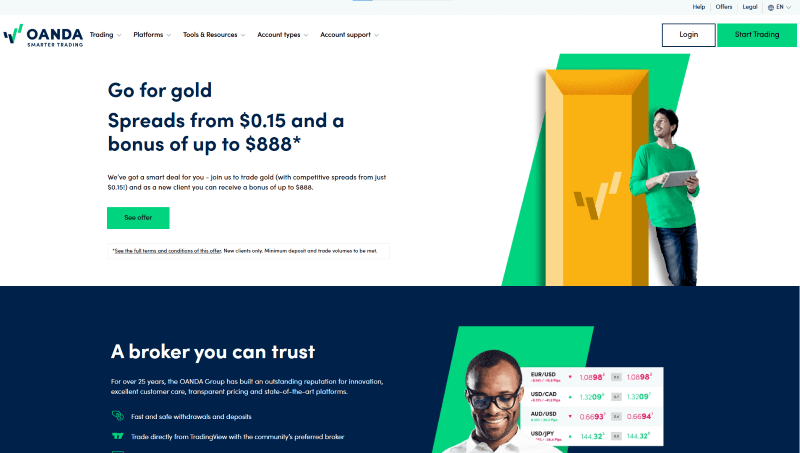
OANDA’s one of the rare forex trading brokers that accepts US clients legally. They’re regulated by CFTC/NFA (0325821), which matters because most international forex brokers avoid the US market due to strict regulatory requirements. I tested them with $300.
Account opening took 15 minutes with SSN verification. Platform choice included MT4, MT5, and OANDA Trade. EUR/USD spreads averaged 1.0-1.1 pips – wider than Pepperstone but acceptable for the regulatory protection. During NFP releases, my orders filled without requotes or platform freezes.
The Core account offered tighter spreads with commission. Market Pulse provided professional research. UK clients get £85,000 FSCS protection. No inactivity fees kicked in until 12 months. Withdrawals processed in 2-3 days with no fees for most methods.
| Characteristic | Details |
|---|---|
| Year of Foundation | 1996 |
| Regulation | CFTC/NFA 0325821, FCA 542574, ASIC 412981 |
| Investor Protection | £85,000 FSCS (UK), CFTC protections (US) |
| Account Opening Time | 15 minutes |
| Minimum Deposit | $0 |
| Currency Pairs | 68 pairs (US), 90+ pairs (international) |
| Spread | From 1.0 pips (standard), tighter on Core account |
| Credit Leverage | Up to 1:50 (US), up to 1:30 (EU retail) |
| Instruments | Forex, CFDs (non-US), 8 cryptos via Paxos (US) |
| Margin Call/Stop Out | Warning at 5% / 50% of margin used |
| Trading Platform | MT4, MT5, OANDA Trade |
| Withdrawal Fee | Free for most methods |
| No Deposit Bonus | No |
| Cent Accounts | No |
| Account Maintenance Fee | $10/month after 12 months inactivity |
| Overall Assessment | Reliable choice for US traders prioritizing regulatory safety |
Pros:
- One of few CFTC/NFA regulated forex brokers accepting US retail clients legally
- Multi-jurisdictional regulation provides strong investor protection across markets
- Platform stability during high-volatility news events in testing
- No withdrawal fees for most payment methods
Cons:
- EUR/USD spreads average 1.0-1.1 pips, wider than top-rated forex brokers
CMC Markets: When You Want 12,000+ Trading Instruments
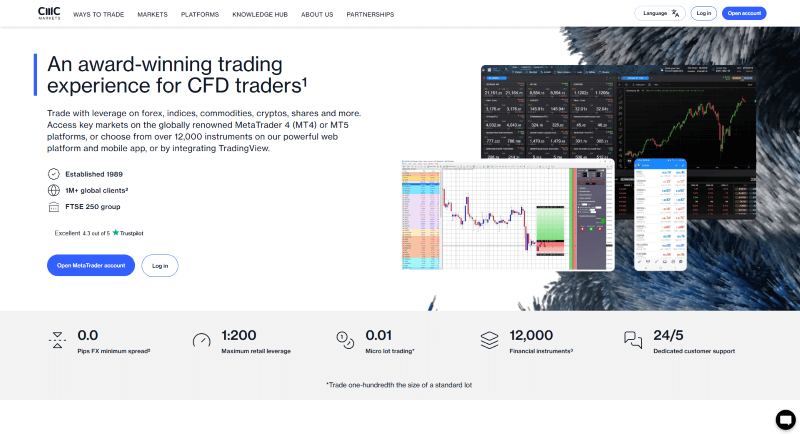
CMC Markets stood out when comparing forex brokers because of their 12,000+ tradeable markets including 141 forex pairs. Most online forex brokers offer 50-80 pairs.
I deposited £200 to test their Next Generation platform. Account opened in 10 minutes. The platform felt advanced – 115+ indicators, pattern recognition, execution averaging 0.003 seconds. EUR/USD spreads averaged 0.6-0.7 pips. The FX Active account offered raw spreads from 0.0 pips plus $5 commission.
CMC’s regulated by FCA (173730) and ASIC (238054), plus they’re publicly traded on LSE (CMCX). UK clients get £85,000 FSCS protection. Demo accounts don’t expire, which is rare among best forex brokers for beginners.
| Characteristic | Details |
|---|---|
| Year of Foundation | 1989 |
| Regulation | FCA 173730, ASIC 238054 |
| Investor Protection | £85,000 FSCS (UK), investor protection (AU) |
| Account Opening Time | 10 minutes |
| Minimum Deposit | $0 |
| Currency Pairs | 141+ pairs (282 including inverse pairs) |
| Spread | From 0.6 pips (standard), from 0.0 pips (FX Active + $5/lot) |
| Credit Leverage | Up to 1:30 (EU retail), up to 1:500 (international) |
| Instruments | 12,000+ (forex, stocks, indices, commodities, bonds) |
| Margin Call/Stop Out | Not specified |
| Trading Platform | Next Generation proprietary, MT4 |
| Withdrawal Fee | Free for most methods |
| No Deposit Bonus | No |
| Cent Accounts | No |
| Account Maintenance Fee | No inactivity fee |
| Overall Assessment | Best for traders wanting extensive market access beyond forex |
Pros:
- 12,000+ instruments including 141 forex pairs exceeds typical forex brokers list
- Next Generation platform with 115+ indicators and fast execution
- FCA and ASIC regulation with £85,000 UK investor protection
- Demo accounts never expire, allowing unlimited practice
Cons:
- Platform complexity may overwhelm beginners seeking simpler interfaces
Questrade: Canada’s Go-To Broker But Forex Isn’t Their Strength
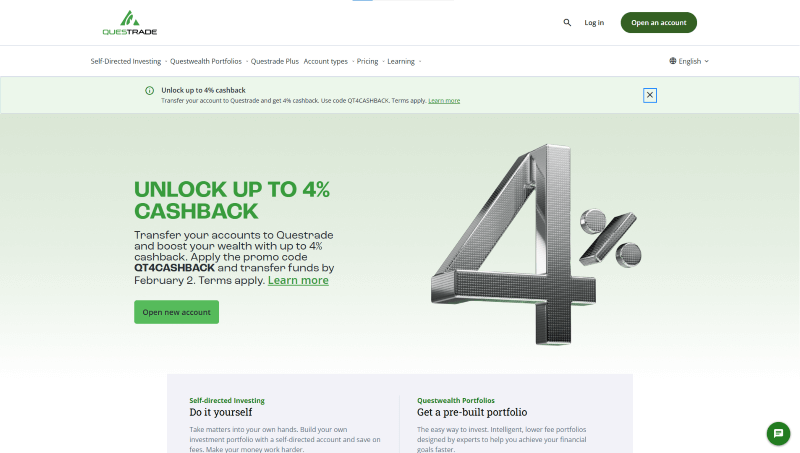
Questrade dominates Canadian investing, but forex isn’t their focus. I tested them because Canadian traders needed a domestic option with CIRO regulation and CIPF protection up to CAD 1 million per account category.
Account opening took 20 minutes with Canadian ID verification. Platform choices included their proprietary platform or MT4. EUR/USD spreads hit 1.9 pips – significantly wider than other brokers for forex trading I’d tested. That spread difference costs real money on active trading.
The strength is Canadian market access with TFSA, RRSP, and FHSA account types for tax advantages. But currency conversion fees of 1.99% on USD/CAD hurt forex profitability. Customer support operates Monday-Thursday 8AM-8PM EST – limited compared to 24/7 support at international forex market brokers.
Questrade works for Canadians prioritizing domestic regulation over competitive forex pricing. For serious forex trading, international regulated forex brokers offer better conditions.
| Characteristic | Details |
|---|---|
| Year of Foundation | 1999 |
| Regulation | CIRO (Canada) |
| Investor Protection | CAD 1M CIPF per account category |
| Account Opening Time | 20 minutes |
| Minimum Deposit | $0 |
| Currency Pairs | Major and minor pairs |
| Spread | From 1.9 pips |
| Credit Leverage | Up to 1:50 |
| Instruments | Forex, stocks, ETFs, options, bonds |
| Margin Call/Stop Out | 100% / 200% or 120 hours |
| Trading Platform | Questrade proprietary, MT4 |
| Withdrawal Fee | Free for most methods |
| No Deposit Bonus | No |
| Cent Accounts | No |
| Account Maintenance Fee | No |
| Overall Assessment | Strong for Canadian equities, weak for forex trading |
Pros:
- CIRO regulation with CAD 1M CIPF protection per account category
- Tax-advantaged accounts (TFSA, RRSP, FHSA) for Canadian residents
- Strong customer support during business hours for account questions
Cons:
- EUR/USD spreads of 1.9 pips far exceed competitive forex trading brokers
- 1.99% currency conversion fee significantly impacts forex profitability
Plus500: Simple CFD Platform With Unlimited Demo
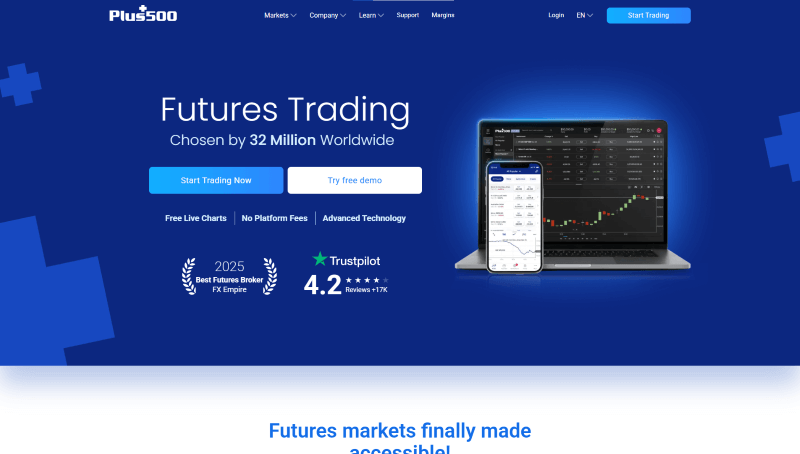
Plus500 focuses on simplicity. The platform targets beginners who find MT4 overwhelming. I tested with $200 to see if commission-free trading and clean interface justified their position among best online forex brokers.
Account opened in 5 minutes. The WebTrader platform felt like a mobile app – clean layout, minimal buttons, easy order placement. EUR/USD spreads averaged 0.8-1.3 pips with no commission. Spread-only pricing meant no math calculating total costs.
Regulated by FCA (509909), ASIC (417727), CySEC (250/14), and publicly traded on LSE (PLUS). UK clients get £85,000 FSCS protection. Demo account is unlimited with no expiration – I could practice without pressure.
Withdrawals allowed 5 free per month, then $10 per additional. My withdrawal processed in 2 business days. Inactivity fee of $10 monthly after 3 months felt aggressive compared to brokers charging after 12 months.
Plus500 works for beginners wanting simplicity over advanced features. Active traders need tighter spreads and better platform tools.
| Characteristic | Details |
|---|---|
| Year of Foundation | 2008 |
| Regulation | FCA 509909, ASIC 417727, CySEC 250/14 |
| Investor Protection | £85,000 FSCS (UK), €20,000 ICF (EU) |
| Account Opening Time | 5 minutes |
| Minimum Deposit | $100 |
| Currency Pairs | 60-70 pairs |
| Spread | From 0.8 pips (average 0.8-1.3 pips) |
| Credit Leverage | Up to 1:30 (retail), up to 1:300 (professional) |
| Instruments | 2,800+ CFDs (forex, stocks, indices, commodities, crypto) |
| Margin Call/Stop Out | Automatic at maintenance margin level |
| Trading Platform | Plus500 WebTrader proprietary |
| Withdrawal Fee | 5 free monthly, $10 per additional |
| No Deposit Bonus | Varies by promotion |
| Cent Accounts | No |
| Account Maintenance Fee | $10/month after 3 months inactivity |
| Overall Assessment | User-friendly for beginners, limited for advanced traders |
Pros:
- Extremely simple interface ideal for forex brokers for beginners
- Multiple tier-one regulations with strong investor protection schemes
- Unlimited demo account with no expiration date
- Commission-free trading with transparent spread-only pricing
Cons:
- $10 monthly inactivity fee after just 3 months more aggressive than competitors
IG: The 50-Year Industry Giant With Everything
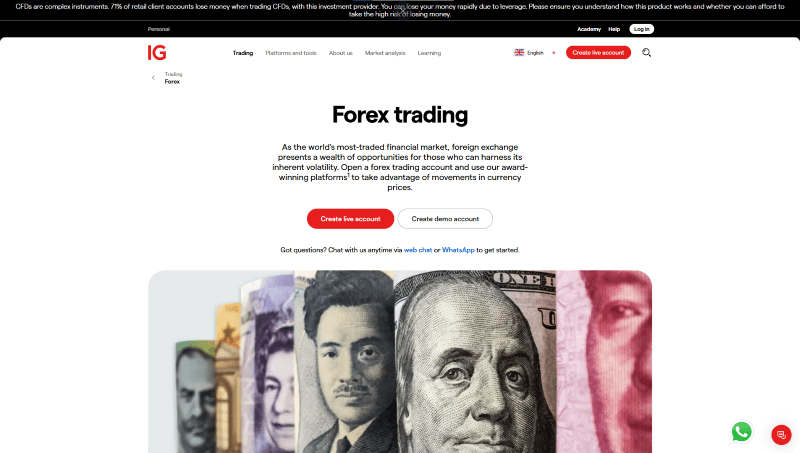
IG operates in the top forex brokers in the world category. Founded 1974, they’re regulated by 8+ authorities including FCA (195355), CFTC/NFA (0509630), and hold a Swiss banking license. I tested with £500 to see if the 50-year track record justified their reputation.
Platform ecosystem impressed me – proprietary web platform, MT4, ProRealTime (free with 4+ monthly trades), L2 Dealer for direct market access, and TradingView integration. EUR/USD spreads averaged 0.6-0.91 pips. The Forex Direct account offered 0.55-0.62 pips plus volume-based commission of $10-60 per million.
IG Academy provided the best education I’d found – structured courses, progress tracking, mobile app, 10 hours daily IGTV analysis. The IG Community had 60,000+ active traders sharing ideas.
US clients access IG through tastyfx (forex) or tastytrade (options/futures). UK clients get £85,000 FSCS protection. Inactivity fee of £12 monthly after 24 months was the longest grace period I’d seen.
IG’s 19,500+ instruments exceeded all other best forex brokers in the world I’d tested. This is the most trusted forex brokers option for traders wanting institutional-grade infrastructure.
| Characteristic | Details |
|---|---|
| Year of Foundation | 1974 |
| Regulation | FCA 195355, CFTC/NFA 0509630, ASIC, 8+ regulators |
| Investor Protection | £85,000 FSCS (UK), CFTC protections (US) |
| Account Opening Time | 10-15 minutes |
| Minimum Deposit | £1 (DMA: £1,000) |
| Currency Pairs | 97 pairs |
| Spread | From 0.6 pips (standard), from 0.55 pips (Forex Direct + commission) |
| Credit Leverage | Up to 1:30 (EU retail), up to 1:200 (professional) |
| Instruments | 19,500+ (forex, stocks, indices, options, bonds, commodities) |
| Margin Call/Stop Out | 100% notifications / 50% after 24 hours |
| Trading Platform | Proprietary, MT4, ProRealTime, TradingView |
| Withdrawal Fee | Free for most methods |
| No Deposit Bonus | No |
| Cent Accounts | No |
| Account Maintenance Fee | £12/month after 24 months inactivity |
| Overall Assessment | Industry-leading platform for serious traders prioritizing reliability |
Pros:
- 50-year operating history with 8+ regulatory licenses worldwide
- 19,500+ tradeable instruments far exceeds typical online forex trading brokers
- IG Academy offers best-in-class education with structured learning paths
- Multiple platform options including MT4, ProRealTime, and proprietary tools
- £85,000 FSCS protection for UK clients under FCA oversight
Cons:
- Higher £1,000 minimum for DMA accounts limits access for some beginners
Comparing Spreads: Why Every Pip Costs You Money

Spread levels directly impact profitability when comparing forex brokers. The spread – the difference between buy and sell price – is how most brokers for forex make money. On EUR/USD, a 0.8-pip spread costs $8 per standard lot, or $16 round-trip. Execute 100 trades monthly and you’ve paid $1,600 in spreads alone.
When doing forex brokers comparison, I tested these recommended brokers forex during normal London hours to measure actual spreads, not advertised minimums. Pepperstone, CMC Markets, and IG consistently delivered the tightest execution among regulated forex brokers I compared.
| Currency Pair | Pepperstone (Razor) | CMC Markets (FX Active) | IG (Forex Direct) |
|---|---|---|---|
| EUR/USD | 0.10 pips + $7 commission (0.8 all-in) | 0.0 pips + $5 commission (0.5 all-in) | 0.55-0.62 pips + $10-60 commission |
| GBP/USD | 0.4-0.7 pips + $7 commission | 0.0 pips + $5 commission (0.5 all-in) | 0.9-1.1 pips + commission |
| AUD/USD | 0.2-0.4 pips + $7 commission | 0.0 pips + $5 commission (0.6 all-in) | 0.6-0.8 pips + commission |
| EUR/CHF | 0.8-1.2 pips + $7 commission | 0.0 pips + $5 commission (0.7 all-in) | 1.2-1.5 pips + commission |
CMC Markets’ FX Active account delivered the lowest all-in costs across all pairs tested. Commission-based accounts from these best brokers for forex trading beat “commission-free” brokers charging 1.5-2.0 pip spreads.
How to Choose the Best Forex Broker
Choosing reliable forex trading brokers determines whether your capital stays protected or disappears, just like picking a best crypto casino. I’ve tested 15+ platforms, and the differences became obvious once I knew what to check.
Regulation and Licensing
Top-tier regulators include the UK’s FCA, Australia’s ASIC, and the US CFTC/NFA. These enforce capital requirements, mandate segregated funds, and provide investor compensation. IG’s FCA license (195355) protected my funds up to £85,000 through FSCS. OANDA’s CFTC/NFA registration (0325821) meant US oversight. Exnova operates from St. Vincent, which doesn’t regulate forex brokers – zero accountability.
Check license numbers directly: register.fca.org.uk, asic.gov.au, nfa.futures.org. Don’t trust broker websites – I’ve seen fake regulatory logos.
Security
Segregated client accounts protect your capital if the broker fails. Pepperstone, CMC, and IG maintain these at tier-one banks. Two-factor authentication adds security. Negative balance protection prevents losses exceeding deposits – mandatory for EU/UK retail accounts. During 2015’s Swiss franc crisis, regulated brokers absorbed losses while unregulated ones left traders owing thousands.
Forex Ranking Position from Traders Union
Cross-reference Traders Union ratings with ForexBrokers.com, WikiFX, and forum feedback. When Exnova scored 1.35/10 on WikiFX with “high risk” warnings across multiple sites, that pattern mattered. Stay updated through forex brokers news from regulatory websites and industry publications to catch warnings about problematic platforms before depositing.
Spreads and Commissions
Calculate total cost per trade. Pepperstone’s 0.1 pips + $7 commission equals 0.8 pips all-in. “Commission-free” brokers at 1.5 pips cost nearly double. On 100 lots monthly, that’s $700 difference.
Trading Conditions
Test execution during news events. Pepperstone filled orders in 50ms during NFP releases. Smaller brokers took 3+ seconds and slipped me 5 pips. Swap rates impact overnight positions. Islamic accounts eliminate swaps – OANDA, Pepperstone, and IQ Option offer these.
Credit Leverage (Shoulder)
EU caps retail at 1:30, US at 1:50. Offshore brokers offer 1:500-1:1000. I tested 1:30 at CMC versus 1:500 offshore. Lower leverage forced better risk management. High leverage blew my $200 account in two days through reckless trades.
Trading Platform
MetaTrader 4 (MT4) remains standard – stable, widely supported, compatible with Expert Advisors. MetaTrader 5 (MT5) adds timeframes and economic calendar. Proprietary platforms like Plus500’s WebTrader prioritize simplicity. Pepperstone’s cTrader offers superior execution transparency.
Deposit and Withdrawal Options
Pepperstone processed my $400 withdrawal in 24 hours. Exnova took six days. Some report waiting weeks at unregulated platforms. Check fees – CMC and IG charge nothing for most methods. Plus500 allows 5 free monthly withdrawals.
Demo Account
IG’s demo never expires. Pepperstone’s lasts 60 days with $50,000 virtual funds. I spent two months practicing before funding live – that saved me money learning order entry and stop-loss placement.
Reviews from Other Traders
Check ForexPeaceArmy, Trustpilot, and Reddit’s r/Forex. Look for patterns across sources. When dozens report withdrawal delays at one broker, that indicates real issues. Cross-reference with regulatory records.
Customer Service
Pepperstone responded under 10 minutes 24/7. Questrade’s Monday-Thursday 8AM-8PM EST hours left me waiting days. Test support before depositing – ask about withdrawals, margins, platform features. Evasive answers suggest problems.
How to Check Reliability
Verify licenses on official regulator sites. Check operating history – IG’s 50 years versus Exnova’s 2022 launch matters. Publicly traded brokers like Plus500 (LSE:PLUS) publish audited financials. Search “[broker name] + warning” to find regulatory actions.
How to Avoid Unregulated Brokers
Avoid platforms advertising 200% bonuses or 1:1000 leverage from St. Vincent, Seychelles, or Vanuatu. Legitimate brokers like OANDA, IG, and Pepperstone rarely offer massive bonuses – their regulation and execution quality attract serious traders. St. Vincent issues “registrations” but provides no oversight.
Report Fraud and Protect Yourself
Document everything – screenshots, emails, chat logs. File complaints with the broker’s regulator (FCA, ASIC, CFTC). For unregulated brokers, report to WikiFX or attempt credit card chargebacks within 120 days. Best protection: only fund regulated brokers with verified licenses. Never deposit more than you can afford to lose. If withdrawals delay or support becomes evasive, stop trading and withdraw immediately.
Which Forex Accounts Match Your Trading Style
Different forex account types suit different trading needs. The best forex trade brokers offer multiple account options matching your experience level and trading frequency.
Demo Forex Accounts for Beginners
Demo accounts let you practice without risking capital. I spent two months on demo before funding my first live account, avoiding expensive beginner mistakes. IG’s demo never expires with unlimited virtual funds, while Pepperstone provides $50,000 for 60 days.
Use demos to learn platform navigation, test order types, and practice risk management. Demo trading feels different psychologically, but it teaches mechanical skills without financial pressure.
For Day Traders and Scalpers
Day traders need tight spreads and fast execution for dozens of daily trades. Commission-based accounts like Pepperstone’s Razor (0.0 pips + $7/lot) or CMC’s FX Active (raw spreads + $5/lot) minimize costs. Every pip matters when scalping 5-10 pip moves.
Platform speed is critical. MT4, MT5, and cTrader execute faster than web platforms. I averaged 50ms execution scalping on Pepperstone’s cTrader during London open. ECN accounts provide direct market access without dealer intervention, reducing requotes during volatile sessions.
For Advanced Investors
Advanced traders benefit from professional accounts offering higher leverage (up to 1:500), lower margin requirements, and dedicated managers. These require €500,000+ portfolio value, professional experience, or high trading frequency to qualify.
IG’s DMA accounts and OANDA’s Core accounts suit experienced traders wanting institutional-grade execution. Advanced accounts include premium tools – IG provides free ProRealTime access, and Pepperstone offers Smart Trader Tools. Multi-currency accounts let sophisticated traders hold positions in various base currencies without conversion fees eating profits.
What Expenses Should You Consider When Trading Forex
Forex trading incurs costs beyond just wins and losses. Hidden fees eat into profitability if you’re not tracking them. I learned this the hard way when my first “profitable” month ended up negative after accounting for all the charges I’d ignored. Understanding the full cost structure helps you compare forex brokers accurately and pick platforms that won’t drain your account through fees.
Spreads (Your Broker’s Commission for Executing Trades)
The spread is the difference between the buy and sell price – how most brokers for forex trading make money. On EUR/USD, a 0.8-pip spread costs $8 per standard lot. That’s $16 round-trip (opening and closing the position). Execute 50 trades monthly, and you’ve paid $800 in spreads alone.
Commission-free brokers earn through wider spreads. A broker charging 1.5 pips “commission-free” costs more than one charging 0.1 pips + $7 commission (0.8 pips all-in). I tracked this over three months – the commission-based account saved me $400 on identical trading volume.
Commission Per Lot
Some forex trading brokers charge spreads plus commission per lot traded. Pepperstone’s Razor account charges $7 per round-turn lot. CMC Markets’ FX Active charges $5. On 100 lots monthly, that’s $700 or $500 respectively. Calculate all-in costs (spread + commission) to compare pricing models accurately.
Non-Trading Fees
Overnight funding (swap rates) apply when holding positions past 5 pm EST. Rates vary by currency pair and broker – typically 0.01%-1.7% of position size. Triple swaps hit on Wednesdays to account for weekends. I held a GBP/USD position for two weeks and paid $34 in overnight fees that I hadn’t factored into my profit calculation.
Inactivity fees punish dormant accounts. Plus500 charges $10 monthly after just 3 months of no trading. IQ Option hits you with €10 after 90 days. OANDA waits 12 months before charging $10 monthly. Pepperstone and CMC Markets charge no inactivity fees, which mattered when I took a two-month break from trading.
Account maintenance fees are rare but exist. Some brokers charge monthly fees regardless of activity – check terms before opening accounts.
Withdrawal Fees
Withdrawal fees vary wildly across online forex brokers. Pepperstone charges $20 for international bank wires, but nothing for card withdrawals under certain conditions. Plus500 allows five free withdrawals monthly, then $10 per additional one. IQ Option gives one free monthly withdrawal, then 2% (minimum $1, maximum $30). CMC Markets and IG charge nothing for most withdrawal methods. Questrade processed my Canadian withdrawals free, but currency conversion fees of 1.99% on USD/CAD ate into profits. Factor withdrawal costs into your broker comparison – frequent withdrawals at high-fee brokers add up quickly.
What Is a Pip in Forex Trading
A pip (percentage in point) is the smallest price movement in forex trading. For most pairs, one pip equals 0.0001. If EUR/USD moves from 1.0850 to 1.0851, that’s one pip. Japanese yen pairs use 0.01 as one pip.
Pip value depends on lot size when trading pairs where USD is the quote currency:
- Micro lot (1,000 units): pip = 10 cents
- Mini lot (10,000 units): pip = $1
- Standard lot (100,000 units): pip = $10
Trade one standard lot and price moves 50 pips? You made $500.
To determine spread in pips, subtract bid from ask. EUR/USD showing bid 1.08500 and ask 1.08508 equals 0.8 pips. Most platforms display the spread size directly.
Different Types of Forex Brokers
You should distinguish between several broker types when choosing where to trade. Each model affects execution, pricing, and potential conflicts of interest.
Market Maker Brokers
Market makers create their own bid and ask prices rather than passing orders to external liquidity providers. They’re the counterparty to your trades – when you buy, they sell to you from their own inventory. Plus500 and IQ Option operate as market makers. The advantage is instant execution with fixed spreads. The downside? Potential conflicts of interest since your losses become their profits. Some market makers restrict profitable traders or widen spreads during news events.
ECN or STP Brokers
ECN (Electronic Communication Network) and STP (Straight Through Processing) brokers route your orders directly to liquidity providers – banks, hedge funds, other traders. Pepperstone and OANDA use this model. You’re trading against real market participants rather than the broker. This eliminates conflicts of interest and typically provides tighter spreads during liquid market hours. Execution depends on available liquidity, so you might experience slippage during volatile sessions.
Prime Brokers and Institutional Liquidity Providers
Prime brokers handle institutional clients – hedge funds, asset managers, big corporations. They’re not accessible to regular retail traders like me. But they matter because retail brokers often connect to prime broker liquidity pools, which gets us better pricing. When I traded at Pepperstone, their liquidity came from tier-one banks and prime brokers, which explained why I got better fills during volatile sessions compared to smaller retail-only brokers I’d tested.
Is Forex Trading Legal in the US?
Forex trading is completely legal in America. I’ve got US trader friends who’ve been doing this for years without issues. You just need a broker with proper licensing, and you’ve got to pay taxes on profits. The IRS treats forex gains differently depending on how you’re classified – talk to a tax person about that.
The CFTC (Commodity Futures Trading Commission) and NFA (National Futures Association) run the show for US forex. CFTC is the federal agency overseeing everything. NFA is a self-regulatory group that keeps brokers in line and maintains a public database at nfa.futures.org where you can verify if a broker’s actually registered.
These regulators don’t mess around. US brokers need registration with both organizations, minimum capital sitting in reserve, client money kept separate from company funds, and regular audits. They cap leverage at 1:50 for majors and 1:20 for minors – way lower than the 1:500 you’ll see offshore.
Only two brokers from my list take US retail clients: OANDA (NFA 0325821) and IG through their tastyfx brand. Most international top 10 forex brokers in the world avoid America entirely because the regulatory headache isn’t worth it.
Frequently Asked Questions About Forex Trading
1.
What is Forex?
Forex is where currencies are traded globally. You’re exchanging one currency for another – buying EUR/USD or selling GBP/JPY – and making money when prices move your direction. It’s massive, over $7 trillion changes hands daily.
2.
Is Forex trading for beginners?
Yes, but don’t skip the learning part. I started on demo accounts at recommended brokers forex like IG and Pepperstone, for two months before risking real cash. Most beginners blow accounts because they jump straight to live trading without understanding risk management. That was almost me.
3.
How does forex trading work?
You open an account with brokers forex, deposit money, and bet on which way currency pairs will move. Think EUR/USD’s going up? Buy it (go long). Think it’s dropping? Sell it (go short). Your profit or loss depends on how many pips it moves and how big your position is.
4.
What is a Forex company?
A forex company connects retail traders to currency markets. They execute your trades, give you platforms like MT4 or MT5, and make money through spreads or commissions. Stick with regulated best forex trade brokers like OANDA or CMC Markets. Stay away from unregulated offshore stuff – I learned that lesson testing Exnova.
5.
Do I have to pay taxes on my profits from Forex trading?
Yes. US traders deal with the IRS, treating forex profits as ordinary income or capital gains depending on your setup. UK traders pay capital gains tax above the annual allowance. Rules change by country. Get a tax pro who knows trading income – I did after my first profitable year, and it saved me headaches.
6.
Is it possible to make money from Forex?
Possible? Yes. Easy? No. Most retail traders lose money starting out. I did too. Making consistent profits took six months on demos, proper position sizing, and actually using stop-losses instead of hoping losing trades would turn around. Check forex brokers news and do proper forex brokers comparison before choosing where to trade. Risk management matters more than finding perfect entry points.
Gambling is risky and can be addictive. Since online casinos involve gambling for real money, it is not important to exercise caution and participate responsibly. The recommendations of our experts do not guarantee success. Before you start, always check whether your gaming activity complies with the laws of your province or territory. Play responsibly and within the legal framework.
- Gambling Therapy : A global service offering free practical help and emotional support to everyone affected by the game.
- Motiv8 : Free confidential help and advice on gambling, gambling, and other addictions.
- Ygam : A British organization that has compiled a catalog of organizations offering help and support on gambling and gambling issues.